Elvanetariam
Cryst Edition
Cryst Edition
- 📦 Digital file available after purchase
- 🔄 Long-term availability
- 🛡️ Secure checkout
- 🔄 Content updated in 2026
Self-paced learning overview
1. Problem Statement
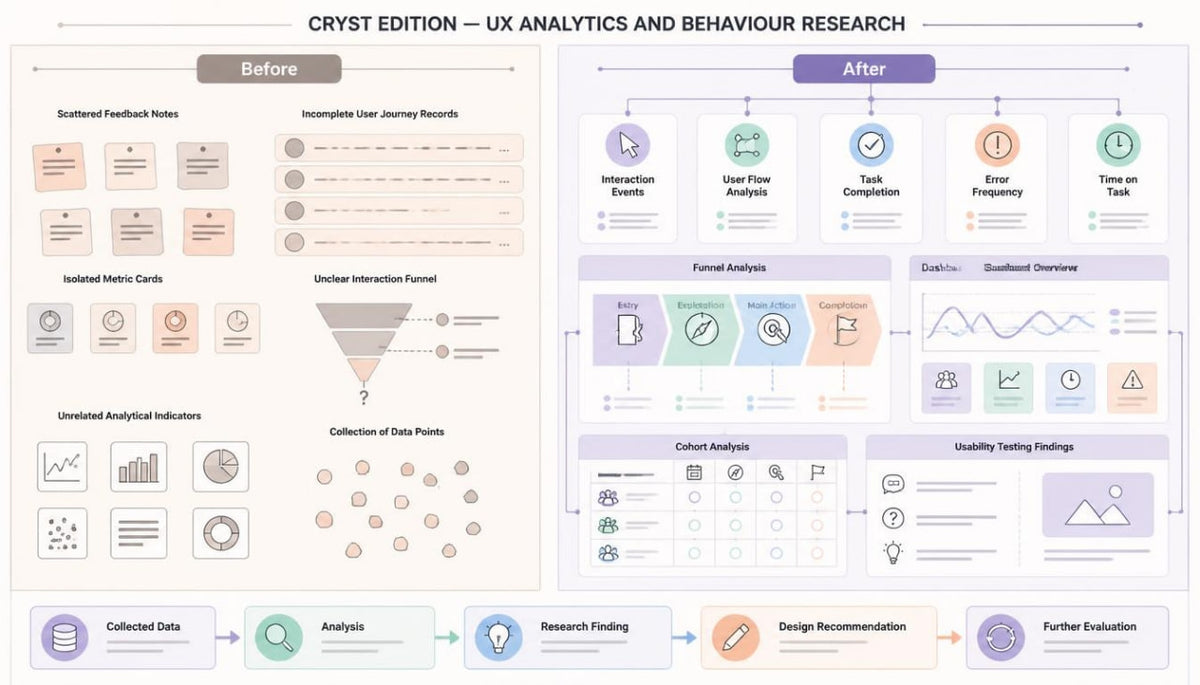
After creating a digital interface, it is important to understand how people actually interact with its elements and whether the intended scenarios are clear. Visual observations and individual feedback do not always provide sufficient information to identify patterns in user behaviour. Without systematic data analysis, it becomes difficult to identify recurring problems, compare different interface variations, and support the need for design changes.
2. Solution
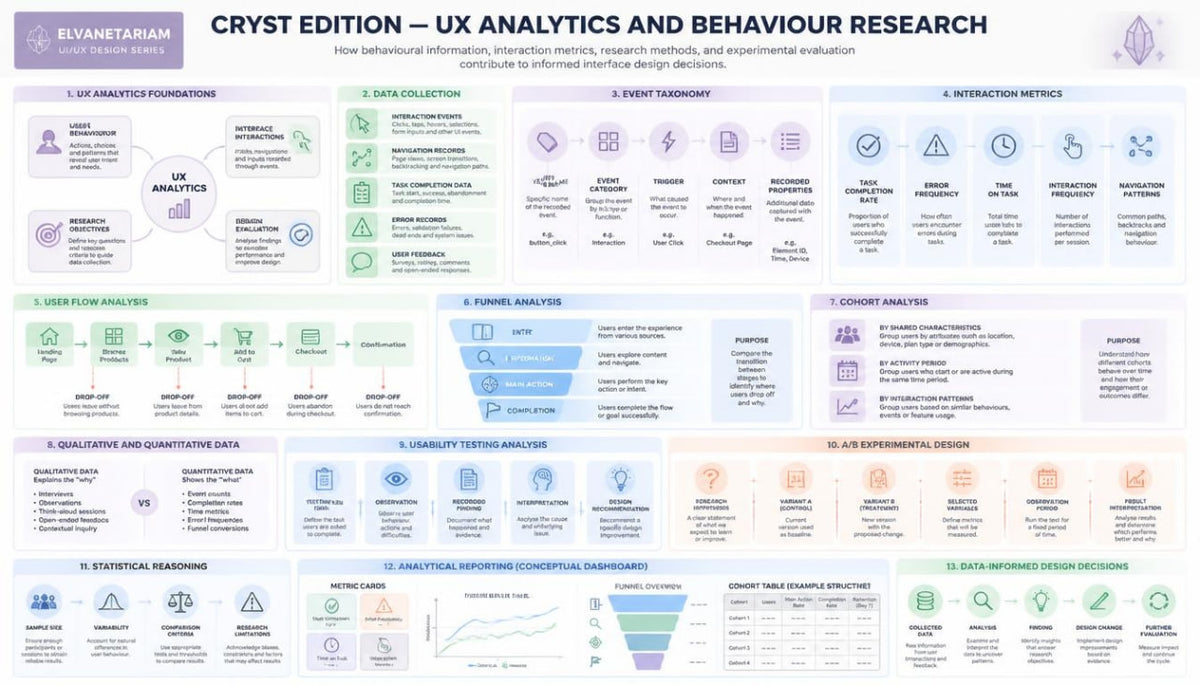
Cryst Edition introduces quantitative and qualitative methods for evaluating user experience, organizing behavioural data, and defining interaction metrics. The learning materials cover user flow analysis, cohort research, experimental testing, and the interpretation of UX research findings. Practical exercises help learners develop analytical conclusions, identify interface problem areas, and document design decisions based on collected data.
3. What's Inside
- Module 1: Foundations of UX Analytics
- Module 2: Behavioural Data and Measurement Principles
- Module 3: Interaction Metrics and Performance Indicators
- Module 4: Event Taxonomy and Tracking Architecture
- Module 5: User Flow Analysis and Drop-Off Patterns
- Module 6: Funnel Analysis and Journey Measurement
- Module 7: Cohort Analysis and User Segmentation
- Module 8: Task Completion and Error Rate Evaluation
- Module 9: Time-on-Task and Interaction Efficiency
- Module 10: Qualitative and Quantitative Data Comparison
- Module 11: Usability Test Results Interpretation
- Module 12: A/B Testing and Experimental Design
- Module 13: Hypothesis Development and Variable Selection
- Module 14: Statistical Reasoning for UX Designers
- Module 15: UX Dashboards and Analytical Reporting
- Module 16: Data-Informed Design Decisions
- Module 17: Research Limitations and Data Interpretation
- Module 18: Integrated UX Analytics Case Study
4. Who Is This For?
A good fit if you:
✅ Already understand foundational UI/UX design principles and want to study the analytical side in greater depth.
✅ Are interested in researching user behaviour within digital environments.
✅ Want to learn how to identify and interpret interface interaction metrics.
✅ Want to explore user flow analysis and sequences of actions.
✅ Are interested in cohort analysis and user segmentation principles.
✅ Want to study experimental testing methods and interface comparisons.
✅ Want to learn how to interpret testing findings while considering research limitations.
✅ Want to support design decisions through quantitative and qualitative data.
✅ Are interested in analytical reporting and research data visualization.
This course may not fit if you:
❌ Are just beginning to study UI/UX design and have not yet explored foundational user experience principles.
❌ Are looking exclusively for materials about graphic composition, colors, and typography.
❌ Do not intend to work with research data and analytical metrics.
❌ Expect in-depth programming rather than UX analytics and interface evaluation.
❌ Want to study visual styling without analyzing user behaviour.
5. What You'll Learn
After studying Cryst Edition, you will be able to:
- Understand the purpose of UX analytics and its role in interface design.
- Distinguish between qualitative and quantitative user experience evaluation methods.
- Define interaction metrics according to research objectives.
- Develop event structures for organizing behavioural data.
- Analyze sequences of user actions within digital environments.
- Identify stages where users discontinue a particular scenario.
- Build and interpret analytical funnels.
- Apply cohort analysis to investigate behavioural groups.
- Evaluate task completion, error frequency, and interaction patterns.
- Analyze time-based measurements of user task completion.
- Compare qualitative interview findings with quantitative research.
- Interpret usability testing results.
- Plan A/B tests and formulate research hypotheses.
- Define variables for comparing different interface variations.
- Understand the foundations of statistical interpretation in research.
- Create analytical dashboards and structured reports.
- Consider sample limitations and possible sources of error when developing conclusions.
- Use research findings to support interface design changes.
6. Refund Information
Refund conditions for Cryst Edition are governed by the Elvanetariam store Refund Policy.
Before placing an order, we recommend reviewing the terms for purchasing digital learning materials, their delivery procedures, and the applicable refund provisions.
Couldn't load pickup availability
Which subjects are covered in the courses?
Which subjects are covered in the courses?
The curriculum covers user research, information architecture, visual composition, typography, prototyping, interactive elements, and design system development.
What is included in each course?
What is included in each course?
Each course has its own module structure and learning materials. A detailed outline of topics, practical exercises, and included resources is provided in the description of each course tier.
Where can I review payment and refund terms?
Where can I review payment and refund terms?
Information about order placement, digital materials delivery, and refunds is provided in the relevant store policies. We recommend reviewing these documents before placing an order.
Share