Elvanetariam
Neon Edition
Neon Edition
- 📦 Digital file available after purchase
- 🔄 Long-term availability
- 🛡️ Secure checkout
- 🔄 Content updated in 2026
Self-paced learning overview
1. Problem Statement
As large digital environments develop, the number of components, templates, styling variations, and interaction scenarios continues to grow. When organizational rules do not account for different interaction methods, information perception, and adaptation to different devices, individual interface sections may lose consistency. Additional complexity comes from recurring components, numerous element states, and the need to maintain one visual language throughout a large-scale system.
2. Solution
Neon Edition presents a systematic approach to large-scale interface development through component architecture, design tokens, and responsive rules. The learning materials explore inclusive interaction principles, keyboard navigation, visual states, contrast, and component behaviour under different usage conditions. Practical exercises focus on developing a scalable design system, analyzing complex scenarios, and documenting rules for consistent component usage.
3. What's Inside
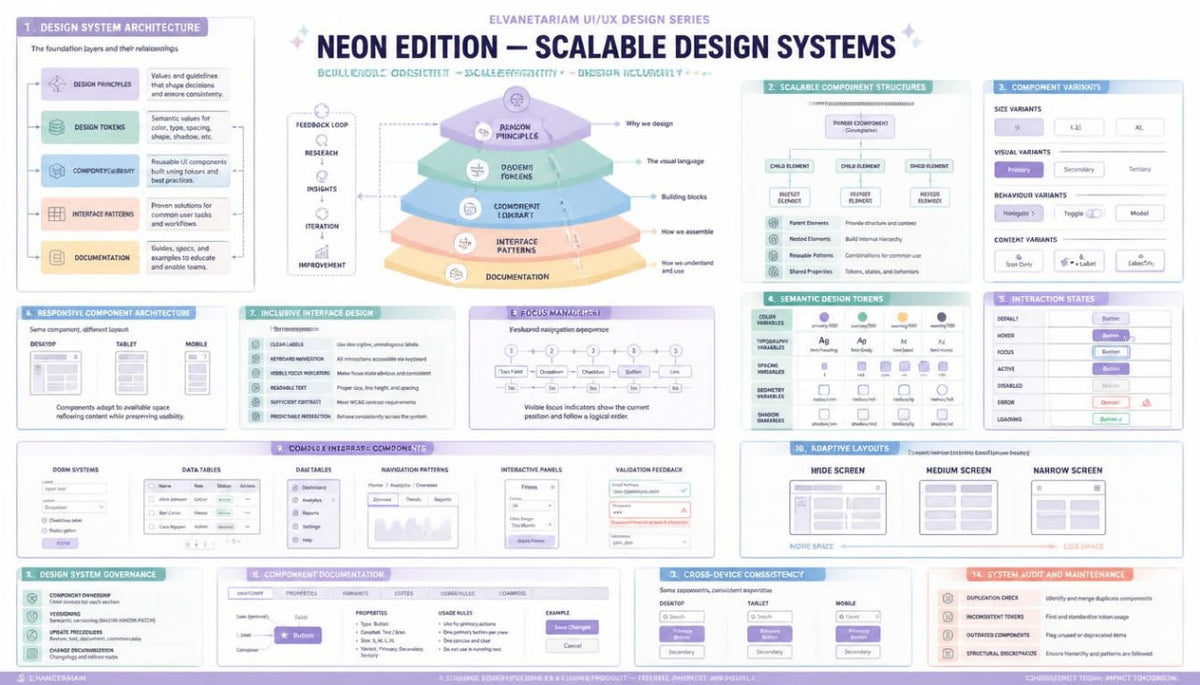
- Module 1: Advanced Design System Architecture
- Module 2: Scalable Component Structures
- Module 3: Component Variants and Property Models
- Module 4: Design Tokens and Semantic Variables
- Module 5: Component States and Interaction Logic
- Module 6: Responsive Component Architecture
- Module 7: Inclusive Interface Design Principles
- Module 8: Keyboard Navigation and Focus Management
- Module 9: Contrast, Legibility and Visual Perception
- Module 10: Complex Forms and Validation Systems
- Module 11: Interactive Tables and Data Components
- Module 12: Advanced Navigation Patterns
- Module 13: Adaptive Layouts and Content Behaviour
- Module 14: Design System Governance and Versioning
- Module 15: Component Documentation and Usage Guidelines
- Module 16: Cross-Platform Interface Consistency
- Module 17: Design System Auditing and Maintenance
- Module 18: Scalable Interface Architecture Studio
4. Who Is This For?
A good fit if you:
✅ Already have experience studying UI/UX design and want to explore interface architecture in greater depth.
✅ Are interested in developing large-scale design systems with extensive component libraries.
✅ Want to learn how to organize complex component variants, properties, and states.
✅ Want to explore semantic design tokens and visual variable systems.
✅ Are interested in inclusive design principles and different methods of interface interaction.
✅ Want to study keyboard navigation, focus management, and the visual representation of interactive states.
✅ Want to design responsive components for different screen dimensions.
✅ Want to learn how to document design systems and organize their usage guidelines.
✅ Are interested in maintaining visual consistency throughout large digital environments.
This course may not fit if you:
❌ Are unfamiliar with the foundational principles of UI/UX design.
❌ Are looking for introductory materials about composition, typography, and interface fundamentals.
❌ Do not intend to study component architecture and the organization of design elements.
❌ Want to focus exclusively on creating individual graphic compositions.
❌ Expect in-depth programming rather than design system development and documentation.
5. What You'll Learn
After studying Neon Edition, you will be able to:
- Analyze the architecture of large-scale design systems.
- Develop reusable component structures.
- Organize properties, variants, and states of complex UI components.
- Create semantic design tokens for colors, typography, geometry, and spacing.
- Define interaction rules between components.
- Design responsive components for different screen dimensions.
- Apply inclusive principles when developing interfaces.
- Understand keyboard navigation logic and focus management.
- Analyze contrast, legibility, and visual information perception.
- Create complex forms with different input validation states.
- Organize tables and components for displaying structured information.
- Design multi-level navigation models.
- Account for content changes when adapting layouts.
- Organize design system versions and their update rules.
- Create component documentation and usage guidelines.
- Maintain visual consistency across different devices.
- Conduct component library audits and identify structural inconsistencies.
- Plan the maintenance and continued development of design systems.
6. Refund Information
Refund conditions for Neon Edition are governed by the Elvanetariam store Refund Policy.
Before placing an order, we recommend reviewing the terms for purchasing digital learning materials, their delivery procedures, and the applicable refund provisions.
Couldn't load pickup availability
Which subjects are covered in the courses?
Which subjects are covered in the courses?
The curriculum covers user research, information architecture, visual composition, typography, prototyping, interactive elements, and design system development.
What is included in each course?
What is included in each course?
Each course has its own module structure and learning materials. A detailed outline of topics, practical exercises, and included resources is provided in the description of each course tier.
Where can I review payment and refund terms?
Where can I review payment and refund terms?
Information about order placement, digital materials delivery, and refunds is provided in the relevant store policies. We recommend reviewing these documents before placing an order.
Share